
You ever get a quote back from a fabricator and think, “Why is this so expensive?”
I’ve been on the other side of that conversation for nearly twenty years. And more often than not, the reason isn’t that the shop is expensive. It’s that the drawing has tolerances that are way tighter than they need to be.
Let me show you how tolerance requirements drive up cost, where you can loosen up without breaking your design, and how smart custom sheet metal fabrication can save you a pile of money
The Simple Truth: Tighter Costs More
Here’s something no CAD software will tell you. Every time you add a “±0.1mm” to a dimension, you’re adding money to the part.
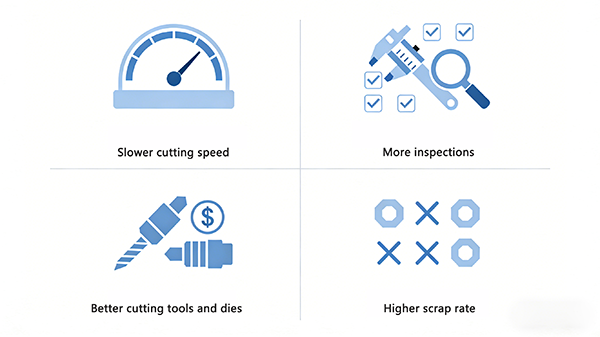
It’s not that shops want to charge you more. It’s that tight tolerances require slower machines, more measurements, better tooling, and more skilled operators. All of that takes time. And time is money.
How Much Does a Tight Tolerance Actually Cost?
Let me give you some real numbers from my shop.
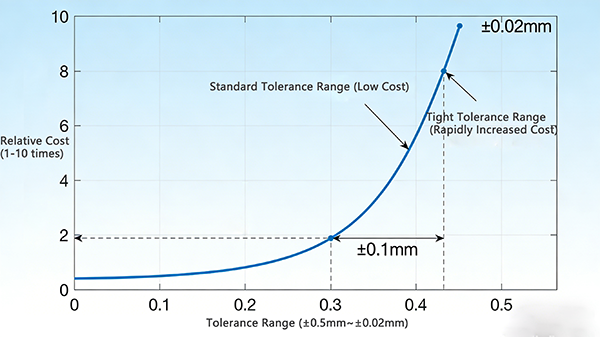
| Tolerance | Relative Cost | Time Impact |
|---|---|---|
| ±0.5mm (standard) | 1x (baseline) | Normal |
| ±0.2mm | 1.5x to 2x | +30% time |
| ±0.1mm | 2x to 3x | +80% time |
| ±0.05mm | 3x to 5x | +150% time |
| ±0.02mm or tighter | 5x to 10x | +300% time |
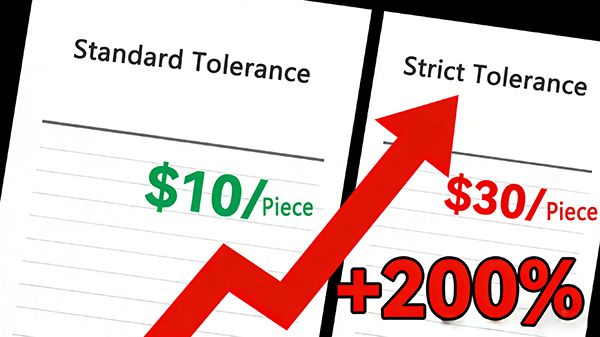
A part that costs you $10 at ±0.5mm could cost you $30 or more at ±0.1mm. And here’s the kicker—most of the time, that part works perfectly fine at the looser tolerance.
Why Tight Tolerances Cost So Much
Let me break down what actually happens when you add a tight tolerance to a drawing.
Slower cutting. To hold a tight dimension, we slow down the machine. A laser that could cut at 10 meters per minute might have to slow to 3 or 4 meters per minute. Same part, three times longer on the machine.
More inspection. A standard part might get checked at the start and end of the run. A tight tolerance part gets checked every 10 or 20 parts. Sometimes every single part. That’s someone’s time.
Better tooling. Standard tooling is cheap and available. High-precision tooling costs more and wears out faster. That cost gets passed to you.
Scrap. The tighter the tolerance, the more parts that fail inspection. Those failed parts still cost you material and machine time.
Where You Can Loosen Up (Without Breaking Your Design)
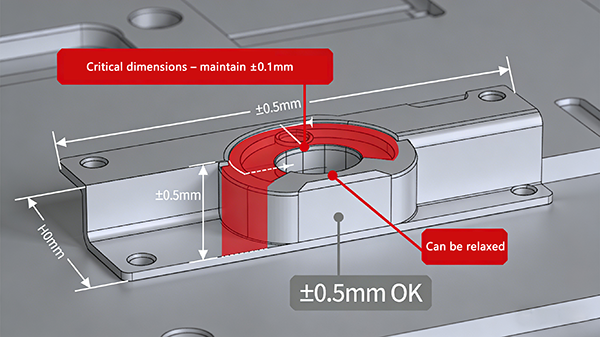
Here’s what I’ve learned after looking at thousands of drawings. Most parts only have three to five features that actually need tight tolerances. Everything else can breathe.
Hole locations. Unless holes are being used for alignment or mating with bearings, ±0.5mm is usually fine. A hole that holds a bolt doesn’t need to be within 0.1mm of its neighbor.
Outer dimensions. Does your part need to be exactly 100.00mm wide? Or does it just need to fit inside an assembly? Most of the time, ±0.5mm is plenty.
Non-mating surfaces. Surfaces that don’t touch anything else don’t need tight tolerances. Nobody cares if a cosmetic surface is off by 0.2mm.
Bend angles. Unless your part is a precision alignment fixture, ±0.5 degrees is standard. Tighter than that, and you’re paying for springback compensation and special tooling.
The Features That Actually Need Tight Tolerances
These are the ones worth spending money on.
Mating surfaces. Where Part A touches Part B, and the fit matters. Bearing seats, shaft interfaces, and sliding surfaces need attention.
Alignment features. Pins, dowels, and registration features that position other parts.
Critical assembly interfaces. If the part bolts to something expensive or safety-critical, that interface deserves tight control.
A Real-World Example: The $5,000 Tolerance
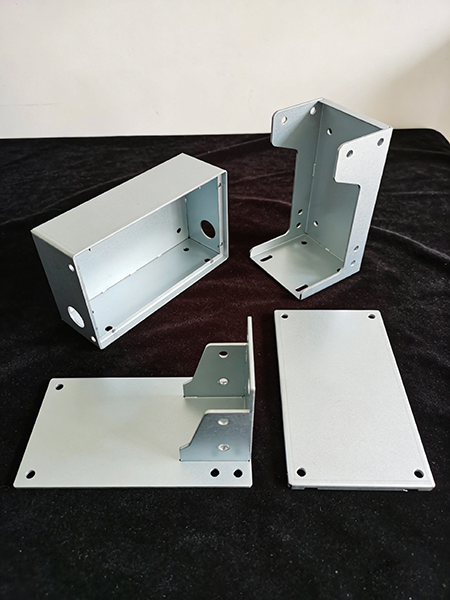
Last year, a customer sent us a drawing for an electronics enclosure. Every dimension on the drawing had ±0.1mm. Every single one. There were over 40 dimensions.
We quoted it at $45 per part. The customer said it was too high.
We asked: “Which dimensions actually matter?” They said only the mounting hole pattern and the lid interface—maybe 6 out of 40 dimensions.
We requoted with ±0.5mm on everything else. New price: $18 per part.
Same part. Same material. Same quantity. Just fewer tight tolerances. The customer saved over $5,000 on that order.
How to Communicate Tolerances on Your Drawing
Here’s a simple system that works.
Use a general tolerance block. Put “All dimensions ±0.5mm unless noted” on your drawing. That covers everything.
Call out tight tolerances individually. For the few features that need it, put the tolerance right next to the dimension. “Ø10 +0.05/-0” tells me exactly what you need.
Use standard tolerances when possible. If your part works at ±0.5mm, don’t tighten it just because you can.
.
Common Tolerance Mistakes I See
Mistake 1: Copying tolerances from a machined part drawing. A CNC machined part can hold ±0.01mm. A sheet metal part can’t. They’re different processes. Don’t use the same drawing.
Mistake 2: Tolerancing every dimension. You’re paying for precision you don’t need. Most parts only need 3-5 tight dimensions.
Mistake 3: Not understanding what “standard” means. Ask your fabricator what their standard tolerance is. Design to that unless you need tighter.
How to Work with Your Fabricator on Tolerances
Here’s my advice after two decades.
Tell us what the part does. If we know it’s a cosmetic cover, we’ll treat it differently than a structural bracket. The more we know, the better we can advise.
Mark critical dimensions. Put a note on your drawing: “Critical dimensions marked with *”. We’ll pay extra attention to those and let the others breathe.
Ask us to quote with different tolerances. Not sure how tight you need? Ask for pricing at ±0.5mm and at ±0.2mm. The cost difference will help you decide.
Trust us when we say you can loosen up. We’re not trying to make your part worse. We’re trying to save you money.
The Bottom Line
Tight tolerances have their place. Bearing fits, precision alignment, and critical interfaces deserve attention and budget.
But most features on most parts don’t need that level of precision. Looser tolerances mean faster production, less inspection, lower scrap rates, and cheaper parts.
The key to cost-effective custom sheet metal fabrication isn’t making everything perfect. It’s making the right things perfect and letting everything else be good enough.
Next time you’re putting tolerances on a drawing, ask yourself: does this dimension actually need to be this tight? If you’re not sure, ask your fabricator. We’ll tell you.
Need help with your sheet metal design? Send us your drawing. We’ll review your tolerances and tell you where you can loosen up without breaking your part.
We reply within 24 hours.
.